AI call center software is transforming customer service from a cost center into a powerful growth engine. Using AI call center software - software de inteligencia artificial para centros de llamadas, modern contact centers can use intelligent routing, virtual agents, real-time coaching, and automated quality assurance to resolve more inquiries, in less time, with fewer resources. Choosing the right AI call center solutions critical for omnichannel customer journeys ensures seamless customer experiences across every channel, while knowing the must-have features for AI-powered contact centers helps you select a platform that truly empowers your agents.
To fully leverage AI call center software, businesses need robust technology infrastructure. Platforms like advanced computing systems provide scalable resources that handle large volumes of customer data efficiently. Similarly, using high performance machines accelerates AI model training, making virtual agents faster and more accurate in real-time interactions.
At the same time, online marketing strategies are essential to drive engagement and retention. Businesses can use insights from effective digital marketing to optimize customer communication and create personalized experiences. Leveraging smart marketing campaigns ensures that AI-powered interactions are integrated with broader customer acquisition and retention efforts, improving satisfaction and loyalty.
Financial planning is equally important when implementing AI solutions. Tools from strategic financial planning help organizations manage budgets, forecast ROI, and make data-driven investment decisions, ensuring that AI call center software delivers maximum efficiency and value.
By combining scalable technology, strategic online marketing, and disciplined financial management, AI call center software enables businesses to offer faster, smarter, and more personalized customer experiences. The right combination of these elements turns your contact center into a growth engine, improving agent productivity and enhancing overall customer satisfaction.
Top 10 AI Call Center Software Solutions
AI call center software is transforming customer service operations, helping businesses reduce response times, improve customer satisfaction, and empower agents with intelligent tools. Choosing the right solution can make a significant difference in your contact center efficiency and omnichannel strategy. Here are the top 10 AI contact center solutions to consider in 2025.
1. Bright Pattern – Advanced AI Contact Center Software
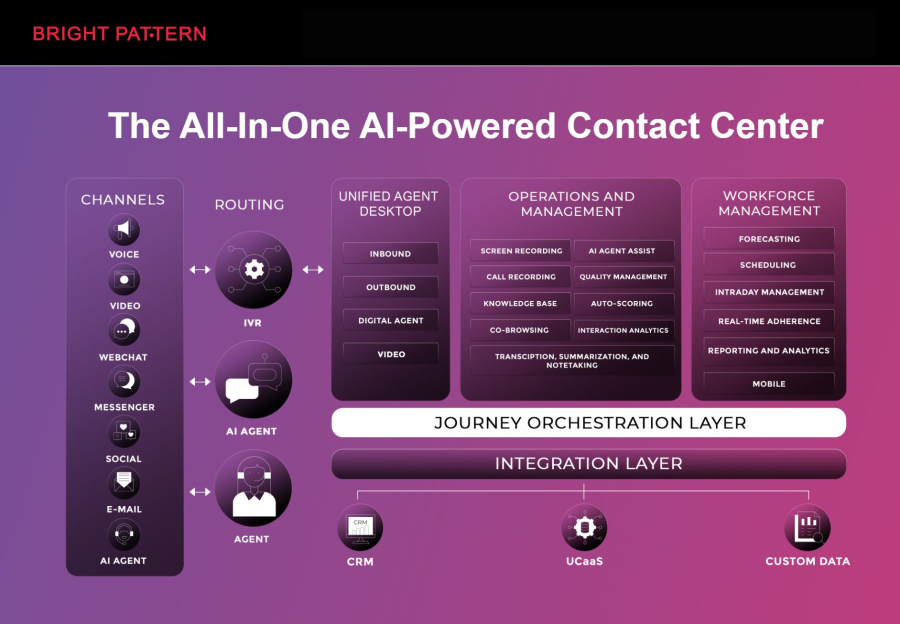
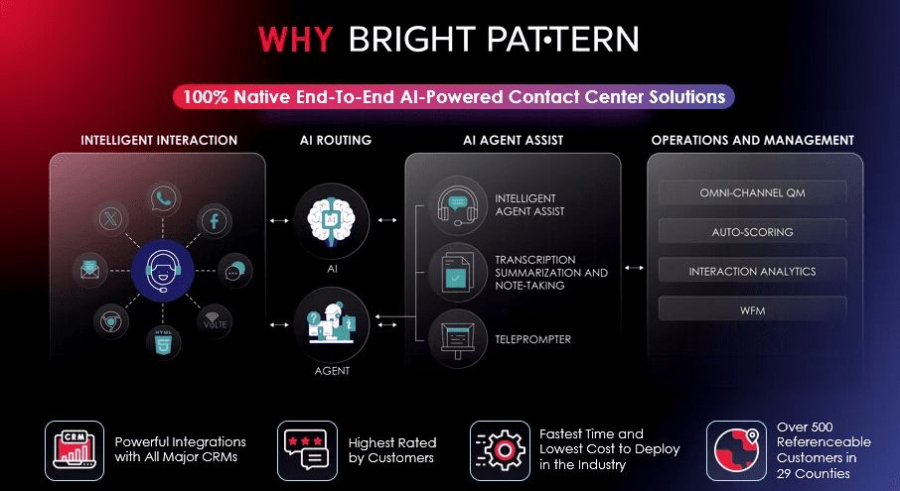
Bright Pattern leads the industry with a robust platform designed to optimize AI call center software for modern enterprises. Its solution integrates intelligent routing, virtual agents, omnichannel support, and real-time analytics, making it a top choice for businesses seeking scalable, efficient contact center operations.
Key features of Bright Pattern AI contact center solutions include:
- Omnichannel customer engagement across voice, chat, email, and social media
- Intelligent call routing that prioritizes high-value interactions
- Real-time agent coaching to improve productivity and resolution rates
- Automated quality assurance for consistent customer service
- Easy integration with CRM systems and business applications
Bright Pattern’s platform is ideal for organizations looking to centralize their AI-powered contact center operations while improving customer satisfaction and operational efficiency.
2. Genesys Cloud CX
Genesys Cloud CX provides a flexible AI-driven platform that supports omnichannel interactions, predictive routing, and advanced analytics, helping businesses enhance customer experiences and agent performance.
3. Five9 Intelligent Cloud Contact Center
Five9 offers a cloud-based contact center solution with AI-powered automation, workforce optimization, and virtual agents, making it easier for companies to manage high volumes of interactions efficiently.
4. NICE inContact CXone
NICE inContact CXone combines AI call center software with analytics and workforce management tools, delivering a seamless customer journey across multiple channels.
5. Talkdesk CX Cloud
Talkdesk CX Cloud uses AI-driven automation and routing to streamline contact center operations while providing agents with actionable insights for faster problem resolution.
6. Avaya OneCloud CCaaS
Avaya OneCloud CCaaS integrates AI and machine learning to optimize call routing, self-service options, and omnichannel support, enhancing both agent efficiency and customer satisfaction.
7. RingCentral Contact Center
RingCentral Contact Center provides AI-powered analytics, intelligent routing, and omnichannel engagement to deliver faster, more personalized support for customers.
8. Zendesk Talk
Zendesk Talk enhances customer service with AI call center software that supports multichannel communication, intelligent ticketing, and analytics to improve agent performance.
9. Cisco Contact Center
Cisco Contact Center solutions leverage AI for routing, virtual agents, and performance analytics, helping enterprises manage complex customer interactions more efficiently.
10. 8x8 Contact Center
8x8 Contact Center uses AI call center software to automate routine tasks, provide real-time insights, and ensure seamless communication across voice, chat, and digital channels.
What Is AI Call Center Software?
AI call center softwareis a set of tools that use artificial intelligence and machine learning to automate, assist, and optimize customer interactions over voice and digital channels. It augments traditional call center technology with capabilities such as:
- Natural language understanding for voice and chat
- Virtual agents and voicebots that handle routine inquiries
- Smart routing based on intent, sentiment, and agent skills
- Real-time agent assistance with suggested answers and next best actions
- Automated call summarization and after-call work
- AI-powered quality monitoring and coaching insights
Instead of relying solely on IVR menus, manual note-taking, and random call sampling, AI call center software listens, analyzes, and learns from every interaction. This allows teams to scale high-quality service without linearly increasing headcount.
How AI Call Center Software Works
While each platform is different, most AI call center solutions combine several core technologies working together in real time.
1. Speech Recognition and Natural Language Understanding (NLU)
When a caller speaks,automatic speech recognition (ASR)converts audio into text.Natural language understanding (NLU)then interprets what the customer is asking, identifies intent, and extracts key details such as names, dates, or order numbers.
This is what enables AI voicebots and virtual agents to understand free-form speech instead of forcing customers through rigid touch-tone menus.
2. Virtual Agents and Voicebots
Virtual agents(sometimes called voicebots or AI agents) can greet callers, authenticate them, answer common questions, update information, and even complete transactions. When they detect a complex or sensitive issue, they can smoothly hand off the conversation to a human agent, along with a concise summary of the interaction so far.
These AI agents are often available 24/7, providing immediate support even outside normal business hours.
3. Intelligent Routing and Queue Management
Traditional call routing often depends on simple rules such as “press 1 for sales” or “send premium customers to a priority queue.” AI adds additional layers of intelligence, including:
- Intent-based routing– Direct customers based on what they actually say, not just menu choices.
- Skill-based routing– Match conversations to agents with the right expertise and certifications.
- Sentiment-aware routing– Detect frustration or urgency and prioritize those callers.
- Workload balancing– Distribute calls to optimize service levels and agent utilization.
4. Real-Time Agent Assistance
As agents speak with customers, AI can providereal-time guidance. Typical assistance includes:
- Suggested responses and knowledge base articles
- Pop-up alerts for compliance statements that must be read verbatim
- Step-by-step workflows for complex procedures
- Live sentiment indicators so agents can adjust their tone and approach
Instead of searching multiple systems while the customer waits, agents get the relevant information delivered to them automatically.
5. Post-Call Automation and Analytics
After the call, AI can take over the time-consuming administrative work:
- Generatecall summariesand disposition codes
- Tag interactions by topic, product, or issue type
- Update CRM fields based on the conversation
- Score interactions for quality, compliance, and customer sentiment
This creates a rich dataset that leaders can use to identify trends, coach agents, and uncover product or process improvement opportunities.
Key Benefits of AI Call Center Software
AI call center platforms deliver value across the entire customer service operation. Here are the outcomes organizations typically see when they implement AI thoughtfully.
1. Faster Response and Resolution Times
With virtual agents handling common questions and AI routing customers to the right human specialist, queues move faster and average handle time (AHT) goes down. Customers spend less time waiting and repeating information, which directly improves satisfaction.
AI also accelerates resolution by surfacing relevant answers and data to agents in real time, reducing hold time and back-and-forth transfers.
2. Higher Customer Satisfaction and Loyalty
AI helps contact centers deliver the type of experience customers now expect: fast, accurate, and personalized. Key drivers include:
- 24/7 availability via virtual agents
- Natural, conversational journeys instead of rigid phone trees
- Context-aware service that recognizes returning customers and their history
- Consistent answers across channels and agents
When issues are resolved quickly and smoothly, customers are more likely to stay loyal and recommend your brand.
3. Lower Operational Costs
AI call center software does not replace your entire team, but it can drastically reduce the volume of work that requires a human agent. Benefits include:
- Deflection of repetitive contactsto virtual agents and self-service flows
- Shorter callsthanks to better preparation, guidance, and after-call automation
- Higher agent occupancywith optimized routing and scheduling
- Less manual QA workdue to automated interaction scoring
The result is a lower cost per contact and the ability to absorb growth without a one-to-one increase in staffing.
4. Empowered, Less-Stressed Agents
AI is a powerful ally for agents. Instead of juggling multiple screens, searching knowledge bases, and memorizing complex procedures, they can focus on building rapport and solving problems.
With AI handling repetitive questions and administrative tasks, agents can spend more time on high-value conversations that use their expertise. This often leads to higher job satisfaction and lower turnover.
5. Better Insights for Leaders
AI call center software analyzes every interaction, not just a small sample. Leaders gain visibility into:
- Top contact drivers and emerging issues
- Customer sentiment trends by product, channel, or region
- Agent performance, knowledge gaps, and coaching opportunities
- Compliance adherence across the entire team
These insights help organizations improve not just their service operation, but their products, processes, and policies as well.
Core Features to Look For in AI Call Center Software
When evaluating AI call center platforms, focus on capabilities that align with your goals. Below are the most impactful features and why they matter.
AI-Powered Self-Service
- Voicebots and chatbotsthat understand natural language and can complete tasks, not just provide static FAQs.
- Omnichannel supportso customers can use the same virtual agent flows across phone, web chat, and messaging channels.
- Seamless handoffto human agents with full context transfer.
Intelligent Routing and Prioritization
- Intent and sentiment detectionto route high-priority or at-risk customers appropriately.
- Skill-based routingwith configurable rules so the right agents get the right conversations.
- Queue optimizationthat balances service levels, SLAs, and agent workloads.
Real-Time Agent Assist
- Suggested responsestailored to the conversation and your brand guidelines.
- Automated knowledge surfacingfrom your documentation and past cases.
- Coaching promptsfor tone, empathy, and compliance statements.
Quality Management and Analytics
- Full interaction transcriptionfor voice and digital channels.
- Automated QA scoringbased on criteria you define.
- Topic clusteringand trend detection across large volumes of interactions.
- Custom dashboardsthat highlight KPIs such as CSAT, FCR, AHT, and containment rate.
Automation of After-Call Work
- Auto-summarizationof calls into concise, structured notes.
- Disposition and taggingof interactions without manual input.
- CRM updatesthat pull directly from the interaction content.
Security, Privacy, and Compliance
- Strongdata encryptionin transit and at rest.
- Configurableredactionof sensitive data from transcripts and recordings.
- Support forindustry regulationsrelevant to your region and sector.
Example: Before and After AI Call Center Software
The following table illustrates how AI changes typical call center workflows and outcomes.
| Aspect | Traditional Call Center | With AI Call Center Software |
| Customer entry point | Touch-tone IVR menus | Conversational virtual agents that understand natural language |
| Routing | Department-based; limited logic | Intent, skill, and sentiment-based routing for better matches |
| Agent preparation | Manual lookup of customer history | Automatic screen pops with history, summary, and recommended actions |
| Knowledge access | Agents search multiple systems while on the call | AI surfaces exact answers and workflows in real time |
| After-call work | Manual notes and disposition codes | AI-generated summaries, tags, and CRM updates |
| Quality monitoring | Small sample of calls reviewed manually | All interactions analyzed automatically with QA scores |
| Scalability | Headcount must grow with volume | Virtual agents handle spikes and off-hours without extra staff |
High-Impact Use Cases for AI Call Center Software
AI call center technology can add value across industries and use cases. Here are some of the most common and effective applications.
1. Customer Support and Technical Helpdesks
For support teams, AI can handle basic troubleshooting, password resets, billing questions, and status checks, while routing complex technical issues to specialized agents. Real-time suggestions help agents resolve niche problems more quickly and consistently.
2. Sales and Lead Qualification
In sales-focused contact centers, AI call center software can qualify inbound leads, schedule appointments, and gather key information before passing the conversation to a sales representative. AI can also analyze conversations to highlight which messaging resonates most and where potential deals stall.
3. Collections and Billing Inquiries
Collections teams can use virtual agents to remind customers about upcoming payments, provide balance information, and capture promises to pay. Human agents focus on negotiation and complex cases, supported by AI that recommends compliant, empathetic language.
4. Order Management and Logistics
For retail, e-commerce, and logistics, AI can instantly provide order status, shipping updates, returns information, and reordering options. This deflects transactional calls and frees agents to handle escalations or special situations.
5. Appointment Booking and Scheduling
Healthcare providers, service businesses, and public sector organizations can use AI to automate appointment scheduling, reminders, and rescheduling requests, dramatically reducing call volumes and no-shows.
Best Practices for Implementing AI Call Center Software
To unlock the full value of AI, it is essential to deploy it thoughtfully. These best practices help you achieve fast wins while building a sustainable long-term strategy.
Start with Clear Objectives
Define specific goals and success metrics before you roll out AI. Common objectives include:
- Reducing average handle time by a certain percentage
- Improving first contact resolution
- Deflecting a share of volume to self-service
- Boosting CSAT or NPS scores
Clear targets help you prioritize features, design your workflows, and measure ROI.
Identify High-Volume, Low-Complexity Interactions
Begin with contact types that are frequent, predictable, and rules-based. These are ideal for virtual agents and automation. Examples include:
- Account balance or order status checks
- Password resets and basic troubleshooting
- Store hours, policy information, and common FAQs
Automating these quickly frees agent capacity and demonstrates early value.
Design Human-Centric Journeys
Customers should always feel like they can reach a human when they need one. When designing AI flows:
- Offer a clear and easy path to speak to an agent.
- Transfer fullcontextso customers do not have to repeat themselves.
- Use language that is natural, friendly, and on-brand.
The goal is to make AI a helpful guide, not a barrier.
Invest in Training and Change Management
Agents and supervisors should understand how AI works, how it supports them, and how to use its insights. Provide:
- Hands-on training with the new tools
- Clear communication about how AI enhances their roles
- Feedback channels so frontline teams can suggest improvements
When agents see AI as an assistant rather than a threat, adoption and performance both improve.
Monitor, Learn, and Iterate
AI systems improve over time as they learn from more data. Regularly review performance metrics and feedback, then refine:
- Virtual agent scripts and intents
- Routing rules and prioritization logic
- QA criteria and agent coaching workflows
A cycle of continuous improvement keeps your AI aligned with changing customer expectations and business goals.
How to Choose the Right AI Call Center Software
The “best” platform depends on your size, industry, channels, and existing technology stack. Use these questions to guide your evaluation.
1. Does it Integrate with Your Current Systems?
Your AI call center solution should work seamlessly with your CRM, ticketing, telephony, and workforce management tools. Strong integrations reduce manual work, eliminate duplicate data, and create a unified view of the customer.
2. Is it Flexible and Scalable?
Look for a platform that can grow with you:
- Supports the channels you use today and plan to add in the future.
- Handles seasonal spikes and long-term volume growth without performance issues.
- Offers configuration options for routing, flows, and analytics without heavy coding.
3. How Strong Are the AI Capabilities?
Evaluate the depth of AI features rather than just the label. Consider:
- Accuracy of speech recognition and language understanding.
- Quality and relevance of real-time suggestions.
- Robustness of analytics, including sentiment and topic detection.
Ask for demos that show realistic interactions similar to your environment.
4. What Controls and Governance Are Available?
You should be able to configure and control how AI behaves:
- Set workflows and guardrails for virtual agents.
- Define QA and compliance rules.
- Limit access to sensitive data based on roles.
Good governance tools help ensure the technology remains aligned with your brand, policies, and regulatory obligations.
5. What Support and Enablement Does the Provider Offer?
Successful AI deployments benefit from strong vendor partnership. Look for:
- Implementation guidance and best practices.
- Training materials for admins, supervisors, and agents.
- Ongoing support and clear roadmap communication.
Simple Example: AI-Assisted Call Flow
Here is a simplified example of how a customer call might look in an AI-enabled environment.
Customer: "Hi, I want to check the status of my recent order." AI Virtual Agent: "Sure, I can help with that. Can you tell me your order number?" Customer: "It is 4827." AI Virtual Agent: "Thank you. I see order 4827 was shipped yesterday and is scheduled for delivery tomorrow. Would you like a text message with the tracking details?" Customer: "Yes, please." AI Virtual Agent: "You are all set. I have sent the tracking link to your mobile number ending in 4521. Is there anything else I can help you with today?" Customer: "No, that is it. Thanks." -- In the background --
- AI logs the interaction in the CRM.
- The conversation is tagged as "order status" and "self-service."
- No human agent time was required, and the customer received an instant answer.
Future Trends in AI Call Center Software
AI in contact centers is evolving quickly. Several trends are shaping the next generation of technology and capabilities.
More Natural, Human-Like Conversations
Advances in large language models are enabling virtual agents that understand nuance, handle multi-step tasks, and maintain context over longer conversations, making interactions feel more natural and productive.
Proactive and Predictive Service
Instead of waiting for customers to call, AI will increasingly predict needs based on behavior and history, then trigger proactive outreach for renewals, issue prevention, and tailored offers.
Deeper Cross-Channel Orchestration
AI is helping organizations connect voice, chat, email, and messaging into a single, continuous journey. Customers can start in one channel and pick up in another without losing context.
More Personalized Coaching for Agents
AI will continue to refine how it supports agents, offering personalized learning paths, targeted micro-coaching, and real-time feedback that reflects each agent’s strengths and development areas.
Conclusion: Turning Your Call Center into a Strategic Advantage
AI call center software is more than a technology upgrade. It is a strategic shift that turns your contact center into a powerful engine for customer satisfaction, retention, and revenue growth.
By combining virtual agents, intelligent routing, real-time assistance, and automated analytics, you can:
- Deliver faster, more accurate service around the clock.
- Empower agents to focus on high-value, relationship-driven work.
- Unlock insights from every interaction to improve your entire business.
Organizations that embrace AI call center software today are building the customer experiences that will define tomorrow’s market leaders. With a clear strategy and the right solution, you can transform your call center from a cost center into a source of lasting competitive advantage.
